Shopper Marketing is a mantra consumer goods companies have been chanting for sometime now and it really began in modern trade outlets in the last decade. Off late companies have started consciously investing in general trade to drive sales. Brands are doing everything from sampling, making testers available and reinventing the way their packs look to get shoppers to notice them. Nikita Rana says companies like GCPL and Marico are reporting a substantial increase in sales as a result of shopper marketing in local stores.
- http://www.youtube.com/watch?v=4LDwqzVLrO0
Friday, September 9, 2011


Wednesday, August 31, 2011
The national pastime by Randy David
This kind of reminds me of how I equated malls as replacement for parks in the Philippines.
Read this blog entry.
The National Pastime
By: Randy David
Philippine Daily Inquirer
The issue first dawned on me many years ago when, in response to my criticism of billboards that have engulfed the city, people from the outdoor advertising industry told me that without them, Manila would be a very dark and unsafe place. Billboards, they said, are what light up the streets and enliven the cityscape. So, did the city’s dark and unlit avenues make commercial billboards a necessity? Or, has the proliferation of billboards relieved the government of its duty to light up and take care of public space? Which one is cause, and which one is effect?
The same issue confronts us when we contemplate the role that gigantic shopping malls play in our national life. One can ask which came first: the failure of government to cultivate alternative venues for public culture and recreation, or, the extensive commercialization of private leisure instigated by capitalism. If these malls did not exist, would we find it necessary to invent them?
It cannot be denied that malls have become so integrated into the rhythm of our daily existence that it is difficult to imagine how Filipinos would use their free time if other options were made available. Would they be spending more time in museums and libraries? Would they be visiting more historic places and heritage sites? Would they be taking more strolls in wooded parks, gardens and public promenades? Would they go to theaters and coliseums, festivals and public lectures, rather than spend a whole day at the mall gawking at people and dreaming of goods they cannot have?
Mall owners would surely say that without the malls, most Filipinos may not know what to do with their time. Their lives would be impoverished and miserable in more than an economic sense. Life in the metropolis would be so drab that, in quest of excitement and the sheer need to break routine, people might instead turn to drugs, gambling, drinking and prostitution. Worse, they could turn to militant mass politics.
Indeed, to the extent they promote the illusion of equal access to the good life, shopping malls in societies like ours have become the most effective instruments for the pacification of class conflict. Unlike the traditional promise of religious salvation in the afterlife, modern consumerist gratification is instant. The levels of fulfillment it offers are matched with one’s current purchasing power. Inside the malls, the good life is not a pie in the sky. It assumes the form of an overflowing cornucopia of material things, whose real value and connection to our lives we are not prompted to reflect upon or examine.
I thought that religion finally acceded to the colonizing power of commerce when Sunday Masses began to be held inside shopping malls. From its pre-eminent perch as the seat of the sublime, religion in the malls became just one of the many events organized by commerce to draw in consumers. In biblical times, the temples of worship drew hordes of vendors and money lenders into their sacred space. Today, it is the other way around.
These cavernous structures we call malls now host the broadest range of activities one can imagine, attesting to the power of a consumer-driven economy. Here you find not just physicians’ clinics but mini-hospitals complete with laboratories. They operate alongside beauty salons, massage parlors (now called spas), children’s playrooms, bowling alleys, techno-game stations, bingo salons, restaurants, movie houses, fast-food joints, banks, ATM cash dispensers, and a wide array of shops selling virtually everything. The malls are the new cathedrals of the consumerist life form, not only aggregating all entrepreneurial activity within their reach, but also significantly turning every facet of social life into their component.
Be that as it may, do we have any reason to complain? Anyone who has ever stepped into these colossal markets, not explicitly to shop but to watch how modern Filipinos have shaped leisure, would be amazed by the manner in which we have constricted the horizons of our being. We have become a people that fatally equates growth with material acquisition, and fulfillment with consumption. This immediately shows in the shallowness of our sense of identity. But, we cannot talk about culture in isolation from the economy.
It is certainly not a coincidence that “malling” emerged as a national pastime at around the same time we started to deploy large numbers of Filipinos for overseas work. Sadly, the billions in remittances that our hardworking OFWs send back have not been utilized to capitalize economic production at home. Instead, they have fueled the growth of a consumer-based economy driven by imports. The more workers we send abroad, the more we consume at home. But, since this consumption is primarily based on imports, the more we consume, the more we need to send people to work abroad.
The foreign origin of most of the goods sold in our malls—from fruits to clothes to gadgets—betrays the gross disconnect between the nation’s productive labor and its consumption. This is not sustainable. People are formed primarily by what they produce, not by what they consume. It is work that builds their culture and makes them into what they distinctly are. All over the country, more shopping malls are being built, yet everywhere our capacity to produce and supply our needs has steadily dwindled. Surely, there is something fundamentally wrong with this kind of development.
Read this blog entry.
The National Pastime
By: Randy David
Philippine Daily Inquirer
The issue first dawned on me many years ago when, in response to my criticism of billboards that have engulfed the city, people from the outdoor advertising industry told me that without them, Manila would be a very dark and unsafe place. Billboards, they said, are what light up the streets and enliven the cityscape. So, did the city’s dark and unlit avenues make commercial billboards a necessity? Or, has the proliferation of billboards relieved the government of its duty to light up and take care of public space? Which one is cause, and which one is effect?
The same issue confronts us when we contemplate the role that gigantic shopping malls play in our national life. One can ask which came first: the failure of government to cultivate alternative venues for public culture and recreation, or, the extensive commercialization of private leisure instigated by capitalism. If these malls did not exist, would we find it necessary to invent them?
It cannot be denied that malls have become so integrated into the rhythm of our daily existence that it is difficult to imagine how Filipinos would use their free time if other options were made available. Would they be spending more time in museums and libraries? Would they be visiting more historic places and heritage sites? Would they be taking more strolls in wooded parks, gardens and public promenades? Would they go to theaters and coliseums, festivals and public lectures, rather than spend a whole day at the mall gawking at people and dreaming of goods they cannot have?
Mall owners would surely say that without the malls, most Filipinos may not know what to do with their time. Their lives would be impoverished and miserable in more than an economic sense. Life in the metropolis would be so drab that, in quest of excitement and the sheer need to break routine, people might instead turn to drugs, gambling, drinking and prostitution. Worse, they could turn to militant mass politics.
Indeed, to the extent they promote the illusion of equal access to the good life, shopping malls in societies like ours have become the most effective instruments for the pacification of class conflict. Unlike the traditional promise of religious salvation in the afterlife, modern consumerist gratification is instant. The levels of fulfillment it offers are matched with one’s current purchasing power. Inside the malls, the good life is not a pie in the sky. It assumes the form of an overflowing cornucopia of material things, whose real value and connection to our lives we are not prompted to reflect upon or examine.
I thought that religion finally acceded to the colonizing power of commerce when Sunday Masses began to be held inside shopping malls. From its pre-eminent perch as the seat of the sublime, religion in the malls became just one of the many events organized by commerce to draw in consumers. In biblical times, the temples of worship drew hordes of vendors and money lenders into their sacred space. Today, it is the other way around.
These cavernous structures we call malls now host the broadest range of activities one can imagine, attesting to the power of a consumer-driven economy. Here you find not just physicians’ clinics but mini-hospitals complete with laboratories. They operate alongside beauty salons, massage parlors (now called spas), children’s playrooms, bowling alleys, techno-game stations, bingo salons, restaurants, movie houses, fast-food joints, banks, ATM cash dispensers, and a wide array of shops selling virtually everything. The malls are the new cathedrals of the consumerist life form, not only aggregating all entrepreneurial activity within their reach, but also significantly turning every facet of social life into their component.
Be that as it may, do we have any reason to complain? Anyone who has ever stepped into these colossal markets, not explicitly to shop but to watch how modern Filipinos have shaped leisure, would be amazed by the manner in which we have constricted the horizons of our being. We have become a people that fatally equates growth with material acquisition, and fulfillment with consumption. This immediately shows in the shallowness of our sense of identity. But, we cannot talk about culture in isolation from the economy.
It is certainly not a coincidence that “malling” emerged as a national pastime at around the same time we started to deploy large numbers of Filipinos for overseas work. Sadly, the billions in remittances that our hardworking OFWs send back have not been utilized to capitalize economic production at home. Instead, they have fueled the growth of a consumer-based economy driven by imports. The more workers we send abroad, the more we consume at home. But, since this consumption is primarily based on imports, the more we consume, the more we need to send people to work abroad.
The foreign origin of most of the goods sold in our malls—from fruits to clothes to gadgets—betrays the gross disconnect between the nation’s productive labor and its consumption. This is not sustainable. People are formed primarily by what they produce, not by what they consume. It is work that builds their culture and makes them into what they distinctly are. All over the country, more shopping malls are being built, yet everywhere our capacity to produce and supply our needs has steadily dwindled. Surely, there is something fundamentally wrong with this kind of development.
Friday, July 15, 2011
SPOTTED: Shopwise premium packaging for private label egg products
Shopwise has taken a different route for its private label (SureBuy) egg products. It's still priced lower than branded eggs but the packaging (which has a halo effect on perceived quality) is very premium. I easily replaced my usual brand and grabbed a box.


Since the usual egg packaging is translucent plastic --- the clean, transparent egg box sent neuro signals of "premiumness" and "quality" to my brain. Maybe because it looks a bit like the Bountry Fresh egg packaging (photo stolen from welovejenni.blogspot.com).

This marks a new trend in the Philippines (this has been happening for a while in NA, Australia and Europe): private label brands are aiming to be perceived much more than a cheap alternative. Supermarkets are starting to see a big opportunity in repackaging and retailing. The own brand labels just need premium space within the category, riding on the halo effect of the supermarket branding.
Thursday, July 14, 2011
SPOTTED: Puregold Corner for Traditional Trade Owners
I always wished for my very own retail lab in the office. With a Traditional Trade set-up, just like Puregold's SSS Corner.
This effort reflects that the management has a good understanding of Puregold shoppers.
This branch is located along Commonwealth Ave. in Tandang Sora, highly targeting Sari Sari Store Owners. They have the SSS Corner at the transition zone of the supermarket, it's literally the first thing that would greet you when you enter.
I love how it helps Sari Sari Store owners figure out the best SKUs (especially single-use sachets or as we fondly call it in the Philippines, "tingi") that they can sell in their stores. It also showcases how different products can be efficiently displayed in a very cramped SSS.
I didn't ask them if they have programs that support this kind of effort. I'm sure they have loyalty cards or some sort of wholesale deals. I got so excited that I just stole a shot then ran out.

This effort reflects that the management has a good understanding of Puregold shoppers.
This branch is located along Commonwealth Ave. in Tandang Sora, highly targeting Sari Sari Store Owners. They have the SSS Corner at the transition zone of the supermarket, it's literally the first thing that would greet you when you enter.
I love how it helps Sari Sari Store owners figure out the best SKUs (especially single-use sachets or as we fondly call it in the Philippines, "tingi") that they can sell in their stores. It also showcases how different products can be efficiently displayed in a very cramped SSS.
I didn't ask them if they have programs that support this kind of effort. I'm sure they have loyalty cards or some sort of wholesale deals. I got so excited that I just stole a shot then ran out.

Too bad I missed the Puregold Sari Sari Convention this year! Click here for a related article.
I want a set-up like this right beside my corner in the office! Universe, thank you!
Saturday, June 11, 2011
EYE TRACKING DEVICE
I was skeptical at first. My colleagues have long been asking me to explore the use of Eye Tracker device for my shopper-in-shopping-mode research. I was thinking it will only be useful for retail stores especially modern trade channels (to gauge premium shelf placement, guarantee best facings and help sell impulse zones). What else can I do with heat and gaze point maps?
It was during the 2011 Shopper Marketing Conference in Sydney, Australia when I met two groups offering this kind of service.
The first was EYE (www.eyecorp.com). Their eye tracking device was a bit big and the receiver console was bulky --- you have to hold it with both hands. I tried it on and noticed that I didn't really mind as I walked around the exhibit area. I was looking at the things I would normally look at, I wasn't really distracted by the device.
I realized that typical advertising research are designed to find out what consumers are thinking about communication, messages and impressions. But we rarely figure out what parts of the ad they look at and which parts they don't look at. When I watched the playback of my "tour" around the exhibit area using the eye tracking device, I was amazed about the length of time I spent looking at communication materials and what counted as "visual noise" in my line of sight.
I was also invited to visit the Objective Eye Tracking booth and they lent me their eye tracker. It was lighter than Eyecorp's device and the receiver console was just a bit bigger than the prehistoric Palm handhelds. But I wasn't allowed to tour the entire exhibit hall wearing it so I just viewed a shelf with different products. A data collection program will show the results of the most, longest, least, etc. viewed products.

Although Objective Eye's Tobii glasses were lighter, it didn't really feel much different from Eyecorp's. But their selling point is that with a less conspicuous pair of glasses, at least the other shoppers won't notice the device. But if you ask me, big difference was the data collection console. It was much smaller and I could keep it in my pocket.

Eye tracking is a good way to augment data when it comes to shelf planogram, packaging designs and in store media placement. But I really think qualitative research is still a valuable tool to contextualize data and give more insightful conclusions.
It was during the 2011 Shopper Marketing Conference in Sydney, Australia when I met two groups offering this kind of service.
The first was EYE (www.eyecorp.com). Their eye tracking device was a bit big and the receiver console was bulky --- you have to hold it with both hands. I tried it on and noticed that I didn't really mind as I walked around the exhibit area. I was looking at the things I would normally look at, I wasn't really distracted by the device.
I realized that typical advertising research are designed to find out what consumers are thinking about communication, messages and impressions. But we rarely figure out what parts of the ad they look at and which parts they don't look at. When I watched the playback of my "tour" around the exhibit area using the eye tracking device, I was amazed about the length of time I spent looking at communication materials and what counted as "visual noise" in my line of sight.
I was also invited to visit the Objective Eye Tracking booth and they lent me their eye tracker. It was lighter than Eyecorp's device and the receiver console was just a bit bigger than the prehistoric Palm handhelds. But I wasn't allowed to tour the entire exhibit hall wearing it so I just viewed a shelf with different products. A data collection program will show the results of the most, longest, least, etc. viewed products.

Although Objective Eye's Tobii glasses were lighter, it didn't really feel much different from Eyecorp's. But their selling point is that with a less conspicuous pair of glasses, at least the other shoppers won't notice the device. But if you ask me, big difference was the data collection console. It was much smaller and I could keep it in my pocket.

Eye tracking is a good way to augment data when it comes to shelf planogram, packaging designs and in store media placement. But I really think qualitative research is still a valuable tool to contextualize data and give more insightful conclusions.
Friday, June 10, 2011
INNOVATION: Energizer Inductive Charger
I wonder how this new technology will impact the retail displays, store technology and even shopper-in-shopping mode research gadgets and technology...
Thursday, June 2, 2011
SPOTTED: Datu Puti maximizes Pacquiao endorsement on-pack.
We often forget about the packaging whenever we do campaigns. In my opinion, on-pack communication is the most powerful in-aisle communication.
A colleague forwarded to me this photo of the most recent Datu Pati packaging. I love that it maximized Manny Pacquiao's endorsement on-pack. I also loved the execution! Mukhasim talaga!

A colleague forwarded to me this photo of the most recent Datu Pati packaging. I love that it maximized Manny Pacquiao's endorsement on-pack. I also loved the execution! Mukhasim talaga!

SPOTTED: Venetian Macau Mall Trail Guides
How do you help tourists not look too touristy when they're lost inside your gigantic mall?
Simple yet innovative, this was the first time I've seen anything like this. Or maybe I just don't go out too often.
When you get to the mall, you choose the trail you want to follow. It really depends which trail the shop you want to visit falls on. Then all you need to do is follow the color-coded line.
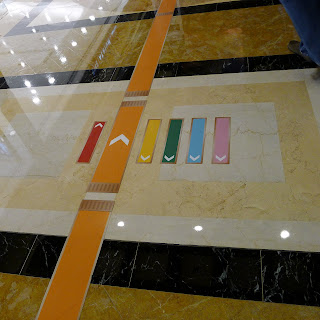

Simple yet innovative, this was the first time I've seen anything like this. Or maybe I just don't go out too often.
When you get to the mall, you choose the trail you want to follow. It really depends which trail the shop you want to visit falls on. Then all you need to do is follow the color-coded line.


How do the blind go shopping?
Whenever we study consumers and shoppers, we always get into Bachelors, HCMs, Teens, Seniors, etc.
I have never thought about how people with disabilities shop.
Seeing this braille mall floor map in Hong Kong got me thinking: How do the blind go shopping?
And yes, kudos to the mall planners who planned with them in mind.


I have never thought about how people with disabilities shop.
Seeing this braille mall floor map in Hong Kong got me thinking: How do the blind go shopping?
And yes, kudos to the mall planners who planned with them in mind.


I searched the web and found this insightful interview in youtube:
How do people who are blind go grocery shopping?
Wednesday, June 1, 2011
SPOTTED: Coca-Cola Check-out merchandising in Disneyland
Coca-Cola has always had the best point of sale merchandising designs. A lot of it has to do with the fact that Coca-Cola has a well-defined brand core. Communication may change and evolve but deep inside we still get the same feeling about it, it still conveys the same message.
I was fascinated with how Coca-Cola can take on the theme of the Disneyland without losing its brand equity. Of course I had to grab a Coke red while lined up on the check out!


I was fascinated with how Coca-Cola can take on the theme of the Disneyland without losing its brand equity. Of course I had to grab a Coke red while lined up on the check out!


SPOTTED: Cute Pork por kilo @ Rustan's Shangri-La
I honestly don't know if I would want to eat pork after seeing this.


It got my attention, alright. But I didn't want a kilo of any part of cutie in my casserole!
Monday, May 30, 2011
Shopper Truths From Around The World | Nielsen Wire
Shopper Truths From Around The World | Nielsen Wire
A jar of mayonnaise or a package of tea is a straightforward product. But if manufacturers market those products in the U.K. the same way they do in the U.S., they are probably making a mistake. Nielsen has compiled the following “shopper truths” from around the world to help consumer packaged goods manufacturers and retailers successfully navigate consumer shopping behavior:
- Same category, different market: often requires a different shopper strategy — While some universal truths exist within categories across borders, success of activation strategies relate to a variety of factors such as local culture, evolving retailer dynamics, pre-store/in-store decision-making, historical promotion strategy, etc. Nielsen’s cross market and cross-category Shopper Modality studies reveal significant differences in levels of category involvement, experimentation and choice drivers.
- In-store is usually not the best place to start selling — A huge amount of shopper decision-making is made on auto-pilot. Nielsen DeltaQualTM tells us that shoppers don’t evaluate all products in-store to make the “perfect” choice-they accept the acceptable, according to sub-conscious choice rules which become ingrained over time to form habitual shopping behavior.
- The best shopper activation strategy is to meet consumer needs – Success is more about meeting consumer needs rather than hitting price points. Ensure an appropriate consumer fit for pack size/count/variety/range through understanding occasionality and/or needs-and as those needs change overtime, build in flexibility to adapt.
- Too many promotions are detrimental to brand and category health in the longer term — Scale and frequency of promotions will set up shopper expectations and create a behavior in shoppers which encourages deal-seeking. Empirical data shows that the more shoppers get used to the deals offered by sales and promotions, the more resistant they are to paying full price.
- Siting matters as much as depth of discount for in-store promotions — On average, feature and display alone provides 66% of sales uplift regardless of discounts offered. Focus investments on securing site rather than diluting price point, and shift the discussion and quantify the opportunity with a discount versus no discount.
- Shopper perceptions do not always equal reality — It’s not always about reality, but what consumersbelieve. Align in-store execution with consumer perceptions-or address the root cause of perceptions: deeply-held beliefs can be hard to overcome.
Saturday, February 19, 2011
WHAT WORKS: The White Hat Italian Frozen Yogurt
Red Mango is still my favorite yogurt place ---because it's the first ever frozen yogurt I really liked.
But I also go to White Hat.
What I like about White Hat is they already have suggested yogurt combos. It's just much easier to order. Especially if your 2 year old keep on asking, "Where is it (yogurt)?" while you're ordering.
White Hat Choco-Loco is our super favorite. She eats all the Oreos and mini kisses while I eat the yogurt and the brownies.
They also have magazines --- probably for the likes of my husband who needs a place to hang-out while waiting for me to finish shopping.


But I also go to White Hat.
What I like about White Hat is they already have suggested yogurt combos. It's just much easier to order. Especially if your 2 year old keep on asking, "Where is it (yogurt)?" while you're ordering.
White Hat Choco-Loco is our super favorite. She eats all the Oreos and mini kisses while I eat the yogurt and the brownies.
They also have magazines --- probably for the likes of my husband who needs a place to hang-out while waiting for me to finish shopping.


*Menu photos courtesy of patikimako.blogspot.com
Thursday, February 17, 2011
SPOTTED: Globe Telecom opens newly-renovated Business Centers
It's refreshing to see that even local service industries are starting to realize the importance of Shopper Marketing. I recently saw the newly-renovated Globe Telecom Business Center in SM Taytay and the new look motivated me to go inside the store.

First off, there was no glass wall. It seemed more inviting. It kind of extended the store.
You could easily see and hear whatever's going on inside, which may trigger Shoppers to look at the available units.
Second, all demo units are actual celphones. You can try the units (yes, even the iPhone 4G) and explore the features.
Then there are the guards dressed in barongs (not the usual intimidating guard uniforms).
They act like an extension of the salesforce, too --- they are well-informed, polite and helpful. They know which flyers to give out, depending on your inquiry. Yes, I didn't get the usual, "Please just ask inside."

The sections are also clearly grouped according to Shopper needs/inquiries.
The model unit section is out front and center, with the accessories right behind it. A waiting area at the side, with a comfortable couch for those waiting for their numbers to be called out. Business and Personal Customer Service inquiries are separate. They even have mood lighting so you feel comfortable spending time there.

Usually, business centers make me feel like I'm in a hospital. But this time, I felt like I was in a mac showroom, free to explore the available units.

You could easily see and hear whatever's going on inside, which may trigger Shoppers to look at the available units.
Second, all demo units are actual celphones. You can try the units (yes, even the iPhone 4G) and explore the features.
Then there are the guards dressed in barongs (not the usual intimidating guard uniforms).
They act like an extension of the salesforce, too --- they are well-informed, polite and helpful. They know which flyers to give out, depending on your inquiry. Yes, I didn't get the usual, "Please just ask inside."

The sections are also clearly grouped according to Shopper needs/inquiries.
The model unit section is out front and center, with the accessories right behind it. A waiting area at the side, with a comfortable couch for those waiting for their numbers to be called out. Business and Personal Customer Service inquiries are separate. They even have mood lighting so you feel comfortable spending time there.

Usually, business centers make me feel like I'm in a hospital. But this time, I felt like I was in a mac showroom, free to explore the available units.
Monday, February 7, 2011
SPOTTED: Fresh Produce Display @ SM Hypermarket
This particular fresh produce brand exerted effort in differentiating their display from the other brands. Usually, vegetables are just placed in crates or baskets. I like the dramatic way the vegetables fall from the basket. It's simple but it makes you think that these are fresher than the other brands. This brand even put some information about the fruits & veggies.
I see this as a good opportunity for cross-merchandising. Any complimentary category product positioned as "fresh" and "natural" would benefit from the halo effect. (I think I mentioned that to a client before but I guess it wasn't taken seriously) Put your products in one of the crates, have a strategic messaging on the stick-outs...
Anyway, back to the display: the only problem is, less people get from this shelf. I think it's seen too much as a "display". You know, things that are nice to look at but forbidden to touch. It's not really that spectacular but the thing is, it's so different from all the other fresh produce displays.
Or maybe...there's a bit of shop-ability problem. Maybe most shoppers are afraid everything will tumble down once they get a piece.
Or maybe...most shoppers that I saw during that time were on an "auto-pilot" mode. Grab and go? Stock up? Refill? Would this appeal better to those in discovery mode?
Or maybe...shoppers don't see vegetables as "branded". They just look at the product (freshness, size, color) and the price instead.
Or maybe...this has been done a million times before and I just never had the time to notice.


I see this as a good opportunity for cross-merchandising. Any complimentary category product positioned as "fresh" and "natural" would benefit from the halo effect. (I think I mentioned that to a client before but I guess it wasn't taken seriously) Put your products in one of the crates, have a strategic messaging on the stick-outs...
Anyway, back to the display: the only problem is, less people get from this shelf. I think it's seen too much as a "display". You know, things that are nice to look at but forbidden to touch. It's not really that spectacular but the thing is, it's so different from all the other fresh produce displays.
Or maybe...there's a bit of shop-ability problem. Maybe most shoppers are afraid everything will tumble down once they get a piece.
Or maybe...most shoppers that I saw during that time were on an "auto-pilot" mode. Grab and go? Stock up? Refill? Would this appeal better to those in discovery mode?
Or maybe...shoppers don't see vegetables as "branded". They just look at the product (freshness, size, color) and the price instead.
Or maybe...this has been done a million times before and I just never had the time to notice.


Tuesday, January 18, 2011
SPOTTED: Marks & Spencer Food and Wine Products @ Rustan's Rockwell
It's a good thing that the people behind Marks & Spencer finally got it:
Shoppers are on a different mission when they enter Marks & Spencer.
I would think it's for personal or gift shopping. Wine product placement, I understand. But the rest of the food products? Not so.
I was pleasantly surprised to see M&S Food and Wine shelves in Rustan's Rockwell. Targeting the right Shopper profile, it's strategically located right between the coffee shelves (a commodity) and the mineral water shelves (which moms usually frequent). I agree with the placement --- it's best for awareness and impulse.
Even the shelf structure was well thought-of: with shelves and hangers for different packaging types. It's like a mini M&S grocery within Rustan's.

Shoppers are on a different mission when they enter Marks & Spencer.
I would think it's for personal or gift shopping. Wine product placement, I understand. But the rest of the food products? Not so.
I was pleasantly surprised to see M&S Food and Wine shelves in Rustan's Rockwell. Targeting the right Shopper profile, it's strategically located right between the coffee shelves (a commodity) and the mineral water shelves (which moms usually frequent). I agree with the placement --- it's best for awareness and impulse.
Even the shelf structure was well thought-of: with shelves and hangers for different packaging types. It's like a mini M&S grocery within Rustan's.

SPOTTED: Mango-Ong in SM Hypermarket Frontera Verde
My husband said it best: Street food is migrating to the malls because that's where the Pinoys hang out nowadays.
Mango with Bagoong*? I think it's brilliant!
There were countless times I wanted to buy mango with bagoong from the streets. But I have a weak stomach so I usually decide against it. But if it's from a stall inside a mall, I will have no hesitations. There's a perception that both the mango and bagoong are cleaner (both handling and preparation).
They chop the mangoes in bite-size pieces, put it on a mini paper plate and ask for your bagoong preference. They have several bagoong options ranging from sweet to spicy.


*Shrimp or Fish paste
Mango with Bagoong*? I think it's brilliant!
There were countless times I wanted to buy mango with bagoong from the streets. But I have a weak stomach so I usually decide against it. But if it's from a stall inside a mall, I will have no hesitations. There's a perception that both the mango and bagoong are cleaner (both handling and preparation).
They chop the mangoes in bite-size pieces, put it on a mini paper plate and ask for your bagoong preference. They have several bagoong options ranging from sweet to spicy.


*Shrimp or Fish paste
Saturday, January 1, 2011
Happy New Year!
Be a self-starter. Do it now! When you do not know how to do something, start. Beware of the paralysis of analysis. Be a person of action. -- Mamie McCullough
Happy New Year everyone!
Let's discover more shopper insights, path to purchase strategies and retail innovations together.
Happy New Year everyone!
Let's discover more shopper insights, path to purchase strategies and retail innovations together.
Friday, December 31, 2010
Old School But It Works: Template Wobbler/Price Strips, Malaysia
Our client approached us, looking for a solution to several cooler merchandising problems:
1. Small Surface between each cooler levels to put labels/price tags on
2. How to put the branding on the labels
3. How to put a semi-permanent labeling, can be easily removed & re-attached (retailers usually arrange products in the coolers differently, even if you provide them with a cooler product placement & merchandising guide)
4. How to grab attention to new products or special price/promos
5. Production of label/tag should be cost-efficient
6. Implementation should be simple and adaptable (different prices per region, different brands inside the cooler, etc).
We started to think of several printing solutions (ranging from special paper to fancy printing processes).
The moment I saw how they do it in Kuching, Malaysia (and in most parts of Malaysia & Indonesia as well), I couldn't help but laugh. Sometimes the solution is just plain simple (and old school).


1. Small Surface between each cooler levels to put labels/price tags on
2. How to put the branding on the labels
3. How to put a semi-permanent labeling, can be easily removed & re-attached (retailers usually arrange products in the coolers differently, even if you provide them with a cooler product placement & merchandising guide)
4. How to grab attention to new products or special price/promos
5. Production of label/tag should be cost-efficient
6. Implementation should be simple and adaptable (different prices per region, different brands inside the cooler, etc).
We started to think of several printing solutions (ranging from special paper to fancy printing processes).
The moment I saw how they do it in Kuching, Malaysia (and in most parts of Malaysia & Indonesia as well), I couldn't help but laugh. Sometimes the solution is just plain simple (and old school).


Photos taken @ Kuching, Malaysia 2010
SPOTTED: Not Your Usual Stall Dividers, Jakarta
It's nice to see that some stall retailers are very creative & ingenious in using their small retail space to: (1) grab attention; (2) create a unique store experience; and (3) help build equity.
Spotted @ FX Mall Jakarta (2010)


Spotted @ FX Mall Jakarta (2010)


Thursday, December 30, 2010
SPOTTED: Starbucks Christmas Sampler in Jakarta
Gives a taste of the experience (not just a taste sample). Attention grabbing as well. Can't help but try one.

Photo taken in Jakarta (Dec 2009)
SPOTTED: 1SGD Ice in a cup? Why not?
For those who want ice-cold drink while on the go.
Or bring home just a cupful for one or two people.
Perfectly placed beside single-serve drinks.

Or bring home just a cupful for one or two people.
Perfectly placed beside single-serve drinks.

Photo taken Jan 2010
SIMPLE GENIUS: Extending the Cooler Shelf for Smaller Products
A simple addition to the Glass-Door Common Cooler: A small item detachable container.
Works as a cooler shelf extender for smaller cold items and as a trigger for impulse purchase.


Photo taken (Jan 2010) from a convenience store in Singapore.
Works as a cooler shelf extender for smaller cold items and as a trigger for impulse purchase.


Also spotted is a simple hanger for cross-category item display. Perfect trigger for impulse-immediate consumption (yup, along with that cold drink!).

SPOTTED: Singapore's own version of a Sari Sari Store (Grassroots Traditional Stores)
7Eleven Store along Orchard Road. They sell mostly small (one-serving or one-way) packs just like in a Pinoy Sari-Sari Store. Funny, even the store clerks are Filipinos.

Photo taken Jan 2010
Sunday, December 5, 2010
Malls: The Pinoys' own version of local parks?
Every weekend, I always end up going to the mall.
Well, I'm guessing 90% of Filipinos end up at the mall during weekends. The figure might be an exaggeration but every mall I go to during the weekend is literally a sea of people. Getting a parking space is like winning the lottery. It's even an accepted fact that you might have to wait a few minutes before getting a parking space.
I recently audited a store in a remote province. It was a standalone store. Meaning, it's not in a mall or a commercial complex. It's a store by the highway. And it surprisingly did well during the weekday. The weekend is a different story. It's like a deserted town. I wouldn't be surprised to see a tumbling weed inside the store. The culprit: the mall 30 minutes away.
It got me thinking, is the mall our new hangout place?
Well, everything you need is there. Food outlets ranging from well-known chains to new concept restaurants to food courts. Groceries. Cinemas. Bookstores. Toy stores. Flower shops. Drugstores.
Nowadays, lists are not just for groceries. It's a mall list:
I need to go to Plains and Prints for clothes.
Watsons for my vitamins
Grocery for stock-up.
The list goes on.
It might include getting a pedicure while waiting for a friend. Or coffee at Starbucks after the movies.
They're geniuses, they got our days planned out for us by carefully selecting the tenants that they have and the brands that they carry. They got shopper profiling --- high end malls with stores and for the affluent; lower-end malls with outlet shops; mostly Chinese clientele with restaurants from HongKong.
Kids now go trick or treating at the mall. You can also have your pets baptized during pet events. Of course, you still shouldn't let your kids just run off. Or leave dog poo on the floor. But all of these concepts revolve around the fact that the malls are where families hang out nowadays. Why not keep them there? Hence, the park-like benches or comfortable sofas. During summer, you can cool off at the mall. You can walk around, do your errands and not perspire for hours.
Retailers know that the longer you keep people inside the store (or the mall), the more people spend. And the more activities you have, the stronger your lure to get foot traffic.
You can also pay your bills and withdraw money without (as much) fear in standalone ATMs or bayad centers.
Why risk getting mugged in the national parks when there are guards roaming around the mall? And there's a paging system as well, just in case little junior wanders a bit too far.
So where are the non-mall hang-outs? There are very few, mostly targeted to the artsy or the affluent.
I guess I'll end up at the mall again this weekend.
Well, I'm guessing 90% of Filipinos end up at the mall during weekends. The figure might be an exaggeration but every mall I go to during the weekend is literally a sea of people. Getting a parking space is like winning the lottery. It's even an accepted fact that you might have to wait a few minutes before getting a parking space.
I recently audited a store in a remote province. It was a standalone store. Meaning, it's not in a mall or a commercial complex. It's a store by the highway. And it surprisingly did well during the weekday. The weekend is a different story. It's like a deserted town. I wouldn't be surprised to see a tumbling weed inside the store. The culprit: the mall 30 minutes away.
It got me thinking, is the mall our new hangout place?
Well, everything you need is there. Food outlets ranging from well-known chains to new concept restaurants to food courts. Groceries. Cinemas. Bookstores. Toy stores. Flower shops. Drugstores.
Nowadays, lists are not just for groceries. It's a mall list:
I need to go to Plains and Prints for clothes.
Watsons for my vitamins
Grocery for stock-up.
The list goes on.
It might include getting a pedicure while waiting for a friend. Or coffee at Starbucks after the movies.
They're geniuses, they got our days planned out for us by carefully selecting the tenants that they have and the brands that they carry. They got shopper profiling --- high end malls with stores and for the affluent; lower-end malls with outlet shops; mostly Chinese clientele with restaurants from HongKong.
Kids now go trick or treating at the mall. You can also have your pets baptized during pet events. Of course, you still shouldn't let your kids just run off. Or leave dog poo on the floor. But all of these concepts revolve around the fact that the malls are where families hang out nowadays. Why not keep them there? Hence, the park-like benches or comfortable sofas. During summer, you can cool off at the mall. You can walk around, do your errands and not perspire for hours.
Retailers know that the longer you keep people inside the store (or the mall), the more people spend. And the more activities you have, the stronger your lure to get foot traffic.
You can also pay your bills and withdraw money without (as much) fear in standalone ATMs or bayad centers.
Why risk getting mugged in the national parks when there are guards roaming around the mall? And there's a paging system as well, just in case little junior wanders a bit too far.
So where are the non-mall hang-outs? There are very few, mostly targeted to the artsy or the affluent.
I guess I'll end up at the mall again this weekend.
Subscribe to:
Posts (Atom)